
Understanding Alachua County Releases
A release closes one custody event. It does not always mean the person walked into the community. The Alachua County Sheriff's Office Department of the Jail may release someone on bond, recognizance, a purge, dismissal, or time served. It may also transfer the person to the Florida Department of Corrections, another county, the U.S. Marshals Service, or ICE. County probation, pretrial release, electronic monitoring, parole, and conditional release add legal duties outside a cell. The booking-out record must be read for its disposition and destination.
The live ACSO portal answers whether a person is currently booked at the jail. It has no release-date field. Once the record drops off, the old booking is not proved released to the community. The Clerk docket may show the order that authorized release, but only the jail record establishes when local processing ended and whether another agency received the person.
- Discharge
- The end of a custody or supervision term recorded by the responsible agency.
- Time served
- Release after the jail verifies that the custodial term in the court order is complete.
- Detainer
- A request or hold that can delay departure or lead to transfer to another authority.
- Recognizance
- Court-authorized release without a financial bond for that case.
Alachua County Release Types
Each label has a narrow meaning. ACSO Booking Support checks court documents, identifiers, payments, and holds before completing the event. A dismissal in one case does not cancel another warrant. A state transport ends the county booking but begins or continues FDC custody. Reading the next-custodian field prevents a transfer from being mistaken for freedom.
| Release wording | What it establishes | Next check |
|---|---|---|
| Cash or surety bond | Valid security supports release in the named case. | Check conditions, holds, and final booking-out time. |
| ROR or purge | A court document or required payment authorizes release. | Confirm no independent hold remains. |
| Time served | The verified county term has ended. | Review amended orders and other jurisdictions. |
| Dismissed or acquitted | The cited prosecution ended without custody on that count. | Check other counts, cases, and detainers. |
| FDC, USMS, county, or ICE transfer | ACSO custody ended through delivery to another authority. | Use the receiving agency's locator or record. |
Alachua County Release Numbers
The ACSO 2024 annual report gives scale without turning annual totals into a live roster. It reported 6,176 bookings, 6,085 releases, an average daily jail count of 889, and 606 transports to FDC. The Jail Release Coordinator also recorded 71 releases into community programs. Those distinct destinations show why a count of people who left the building is not a count of community releases.
These are historical annual figures. They cannot identify who was released today or confirm one person's status.
Inside an Alachua Release Record
A precise county request ties the event to the person and booking. Ask for the existing booking-out or release record rather than a custom report. ACSO may hold only some requested fields for a given event, but naming each field helps staff find the record and limits ambiguity.
| Field | What it shows |
|---|---|
| Full name and MNI/JBN | Links the release to the correct ACSO person and booking identifiers. |
| Booking date and time | Marks the start of the local custody event. |
| Release date and time | Shows when ACSO completed booking-out processing. |
| Disposition or authority | Names bond, recognizance, time served, order, dismissal, or other basis. |
| Destination or receiving agency | Distinguishes community release from FDC, county, USMS, or ICE transfer. |
| Hold or transfer notation | Explains why one release authority did not produce immediate community departure. |
| Booking photograph | Associates the official image with the named booking when releasable. |
For the legal reason behind the event, compare the release record with the Alachua Clerk criminal docket. A filed bond order, judgment, sentence, dismissal, or amendment explains authority. It does not replace the jail's actual exit time.
Request Alachua County Release Records
ACSO accepts public-record requests online, by telephone through Department of Jail Records at (352) 491-4444, or in person. The Records Customer Service Window is at 2621 SE Hawthorne Road in Gainesville and is open 7 a.m. to 7 p.m. Monday through Friday. Florida requesters generally need not give a purpose or identify themselves.
- Give the full name, date of birth if known, MNI or JBN, and an approximate booking or release range.
- Ask for the existing booking-out or release record, including date, time, authority, destination, transfer notation, and booking photograph where those fields exist.
- Request native electronic format when practical and ask for the statutory basis of any redaction.
- Compare the response with the Clerk docket and the receiving agency's record when the event was a transfer.
ACSO's published charges begin when a request reaches 20 pages or takes more than 15 minutes of staff work. Listed copy rates are $0.15 for a single-sided page and $0.20 for a double-sided page, plus applicable postage. Labor beyond the first 15 minutes is based on salary and benefits to the nearest quarter-hour. Payment is due before production.
Alachua Release Access and Retention
Florida Statute § 119.07 requires reasonable access to nonexempt public records and a good-faith response. It permits lawful redaction and special-service charges for extensive work. Florida's GS2 schedule lists minimum retention of one anniversary year after release for booking records, commitment and release lists, and incarceration records. Jail docket books are permanent. A minimum retention rule does not promise that an old item remains on a public website.
Juvenile, forensic mental-health, medical, sealed, and expunged material can be restricted. Florida §§ 943.0585 and 943.059 govern expunction and sealing. The Clerk's local process requires an FDLE eligibility certificate and court filing, but eligibility depends on the case. A sealed or expunged item may vanish from public access, while authorized agencies can retain statutory access.
A public release date does not make every part of a jail, juvenile, medical, or FDC file public.
Correct an Alachua Release Record
No dedicated ACSO web form was found for correcting a booking-out entry. Start with the agency that created the disputed field. For a wrong release time, destination, MNI or JBN link, or photograph, give Department of Jail Records or Booking Support the exact booking identifier, the value at issue, and the document that supports a correction. Booking Support enters release data and checks judgments, sentences, and amended orders, which makes it the practical first route. Staff review does not guarantee that a record will change.
If ACSO accurately copied an incorrect court order, obtain the docket entry and a certified copy from the Clerk. Any correction to that filed instrument must follow the court's lawful process before the updated order goes back to the records custodian. A disputed FDC Current Release Date belongs with the FDC Bureau of Admission and Release, while a population-history issue belongs with FDC Central Records.
A later status change is not always an error. A new order, lost gain-time, detainer, return to custody, or transfer can leave the earlier release event valid. Ask for the dated event history so both facts remain visible.
When Alachua Jail Releases Finish
Ordinary first appearance begins at 9 a.m. on weekdays and 9:30 a.m. on weekends and holidays, according to ACSO Booking Support. A judge's release order starts final processing; it does not set the moment a person walks out. Processing may take several hours.
Document errors, delayed court paperwork, active warrants, detainers, required registration or testing, electronic monitoring, Nebbia review, living-arrangement checks, medical events, security events, and technical problems can all slow departure. The safe answer is the recorded booking-out time, not a prediction based on the hearing clock.
Posting an Alachua Release Bond
ACSO accepts bonds at the jail lobby window from 6 a.m. to 11 p.m. An after-hours service window sits to the left of the front entrance. The official bail and release page separates cash bond, surety bond, purge, and time-served workflows. Booking Support verifies the matching papers and identifiers before release.
The 24-hour supervisor line is (352) 491-4459. A bond applies to the named case; another warrant or hold can still prevent community release. For that reason, a payment receipt or court authorization should be followed by confirmation that booking-out is complete.
Property After an Alachua Release
The ACSO inmate handbook gives local rules for property and money. A person in custody signs an authorization for property release, and property is generally released after 1 p.m. One set of clothes is held for the person's own release. Money release is limited to one request.
If a commissary order arrives after departure, ACSO holds it for ten business days. Pickup is by appointment and requires identification. These tasks concern personal items, not proof of custody status, yet they often matter immediately after the recorded release event.
Find Released Alachua County Inmates
Begin with the last known custodian. A person arrested locally may have left ACSO for the community, state prison, another county, federal custody, or immigration custody. Each outcome creates a different record. The current jail roster is only the first check.
- Search the ACSO live portal by name or booking number to test for current local custody.
- If the person is absent, request the ACSO booking-out record and ask for destination or receiving agency.
- Read the Clerk docket for the bond, release order, disposition, judgment, or sentence.
- Check FDC Inmate Release and Supervised Population when state custody or state supervision is possible.
- Use Florida VINE for alerts, BOP for federal prison history, ICE ODLS for immigration custody, and PACER for a federal court event.
Roster disappearance proves only that the current portal does not show the booking. It does not prove community release.
FDC Search for Alachua Releases
The FDC Corrections Offender Network separates active inmates, released inmates, supervised people, and absconders. Choose Inmate Release Information Search for someone who entered state custody. It covers people already released or scheduled for release and updates release information nightly. It does not cover an Alachua County jail-only sentence or county probation.
| Search field | Use |
|---|---|
| Last and first name | Prefix searches identify possible records. |
| DC number | The six-character state identifier gives the closest match. |
| Aliases | Expands a name search when another name may be recorded. |
| Release Date | On a released detail, shows departure from FDC custody for that record. |
| In/out custody history | Shows dated state custody periods and later returns. |
The official search hub is shown below. Starting at the hub preserves the correct database choice when direct session links expire.
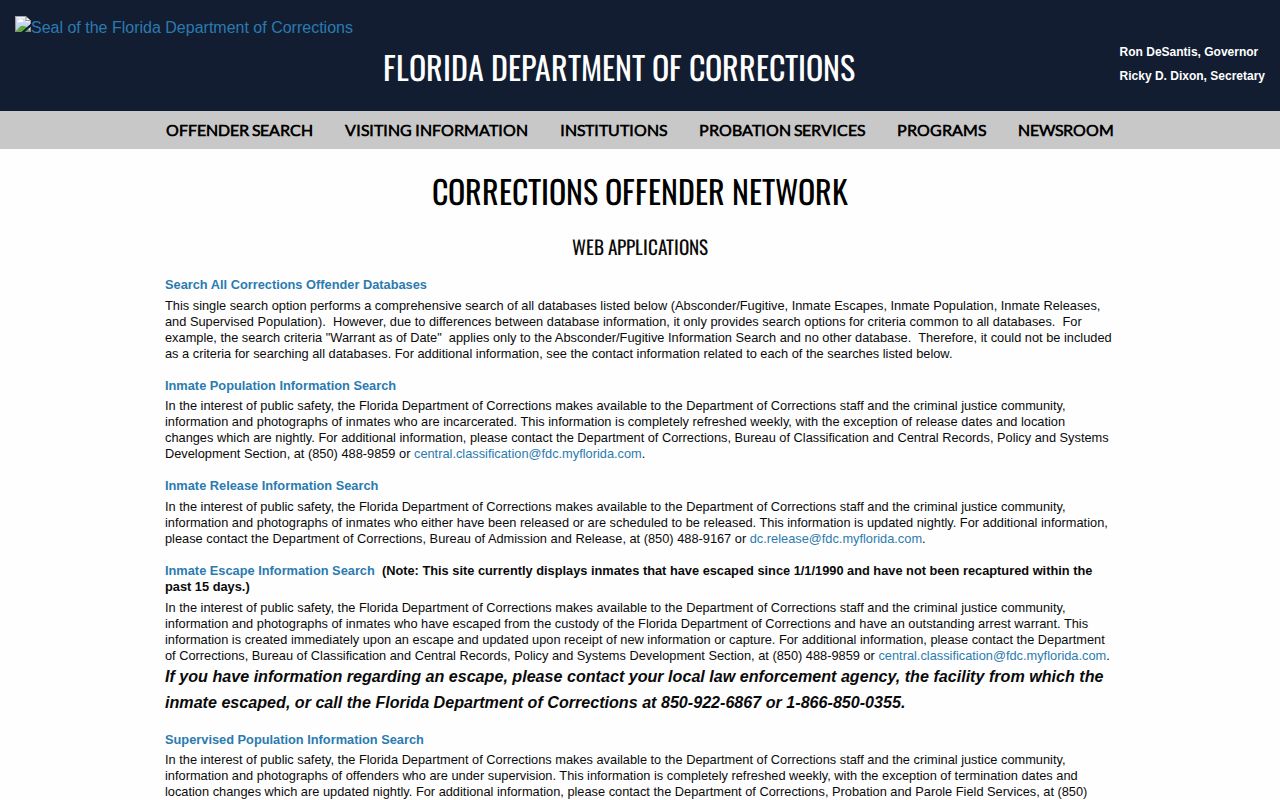
The menu's separate databases are a reminder that current custody, release history, and supervision are not one status.
Alachua County Recent Release Limits
ACSO publishes no official 24-hour or 72-hour release feed. Its public portal offers last name, first name, booking number, and View All for current inmates. There is no release-window selector or release field. A person who needs an existing release event from today should request that named booking-out record. A three-day question should include a date range and ask whether an existing commitment or release list is maintained.
The official sheriff app listing documents news, reports, tips, and public-safety functions. It does not promise an inmate lookup, archive, or recent-release feed. The V3 Jail Releases: 24 Hours route explains the same-day fallback without presenting the current roster as a release list.
Alachua Release Supervision Searches
FDC's Supervised Population search shows state probation, community control, parole, conditional release, and other state supervision. A record may include the start date, scheduled termination date, current status, supervision type, offense history, and photo. “Active Suspense” can mean confinement elsewhere. “Absconder” means a violation warrant has issued because the person is unavailable to supervision.
Alachua County Court Services runs separate county probation and pretrial programs. Those county-only cases do not appear in the state database. The Gainesville FDC circuit office handles state supervision. The distinction is developed on the Probation & Parole page.
Help After an Alachua Release
The former county Work Release program closed in 2022. The local Released Reentry partnership now offers a transition layer documented by county and ACSO materials. Work begins in jail with intake and goal assessment. Reentry 101, library resource workshops, welcome-home kits, and bus passes can support the move back into the community.
Released Reentry is at 4104 NW 13th Street in Gainesville and can be reached at (352) 432-8600. The service does not prove release status. It addresses needs after the jail and legal records establish the event.
Alachua Release Alerts and Federal Records
Florida VINE provides a specific-person custody check and notification registration for participating Florida jails and FDC. It is available by phone at 1-877-846-3435 around the clock. A release alert can mark transfer from one agency, so confirm it with the named facility. VINE is not a formal release certificate.
Federal prison history belongs in the BOP Inmate Locator. A past Release Date with Location “RELEASED” confirms departure from BOP custody, not the end of court supervision or state custody. ICE ODLS uses an A-number or exact name and country of birth. USMS pretrial release instead requires the federal docket and holding-facility check because the Marshals Service has no comparable public release locator.
ICE After an Alachua Release
A February 2025 ACSO-ICE Warrant Service Officer agreement creates a sharp local boundary. A designated person can be released from criminal custody and then transferred to ICE. Immigration custody begins after local law-enforcement release. An ICE detainer may also request notice and a hold of up to 48 hours beyond ordinary release so DHS can assume custody.
Neither event proves removal from the United States. Ask ACSO for the destination or receiving agency, then use ICE ODLS after the transfer has had time to enter the system. ICE states that ODLS includes current detainees and some people released from ICE custody within 60 days.
Where Alachua Release Records Live
The same name can appear in more than one system because each office records its own custody or legal act. Match the search to the event being proved.
| System | What it proves | Key limit |
|---|---|---|
| ACSO live portal | Current county-jail custody | Absence is not a release record. |
| ACSO booking-out record | Local release time, authority, and destination where recorded | Does not prove a later FDC, BOP, or ICE outcome. |
| Clerk docket | Filed legal authority and case disposition | Does not prove the hour the jail finished processing. |
| FDC Inmate Release | State-prison release history | Excludes county-jail-only stays. |
| BOP locator | Federal-prison release | Excludes ICE and USMS pretrial custody. |
Alachua County Release Facilities
Alachua's secure facilities span adult county custody, juvenile justice, state corrections, community release, and forensic mental health. Their release records are not interchangeable.
- Alachua County Sheriff's Office Department of the Jail: use ACSO booking-out records and the receiving agency when a transfer occurs.
- Alachua Regional Juvenile Detention Center: DJJ and juvenile-court orders control guardian release, placement, or transfer.
- Alachua Academy: transition from the girls' residential program depends on DJJ assessment, treatment progress, and court authority.
- Gainesville Work Camp: verify current operation with FDC, then use FDC records for placement or discharge.
- Bridges of Santa Fe: residence at the community-release center remains an FDC placement until formal discharge.
- North Florida Evaluation and Treatment Center: DCF and forensic-court records govern conditional release, discharge, or transfer.