
Alachua Three-Day Release Records
ACSO's public system is a current inmate roster, not an Alachua County 72-hour release list. The form has name and booking-number inputs plus View All, but it has no recent-release option. No official three-day feed, update schedule, or online retention period was found. The safe three-day method is to define the period and ask ACSO for existing booking-out or release records within it.
A broader date range is useful after weekends and holidays. A Friday order may not result in completed processing at the same moment. Likewise, a Sunday booking-out event may not fit a Monday morning user's idea of “today.” The records request should state the start and end date, then ask whether ACSO maintains an existing commitment and release list that can be inspected. The agency need not create a new report if none exists.
Check Alachua 72 Hour Releases
Write down the exact three-day span before searching. “Over the weekend” can be unclear when an order, a bond payment, and final booking-out fall on different dates. Use the following sequence for one named person or for an existing date-based record.
- Search the current ACSO roster. A result means current local custody; absence alone does not prove release.
- Call Department of Jail Records at (352) 491-4444 with the name, known MNI or JBN, and the three-day range.
- Use the ACSO public-record request route. Ask for an existing release or booking-out entry, exact time, disposition, hold notation, and destination.
- Check the Alachua Clerk docket for a bond, ROR, dismissal, judgment, sentence, or amended order during the same period.
- Use Florida VINE for a custody-change alert, then verify the event with ACSO or the receiving agency.
For a release that happened only today, the Alachua 24-hour release check narrows the same process to a single day. The three-day method is designed for spillover, not for republishing current inmates as released people.
Alachua Release Fields to Request
There are no public Alachua County 72-hour feed fields because no such feed is offered. A focused records request can seek the fields that resolve a release event. Request them precisely, but do not promise that every item exists in every file.
| Requested field | Why it matters |
|---|---|
| Name and MNI/JBN | Matches the right person and booking across the three-day range. |
| Booked date and time | Separates the custody event from older or later bookings. |
| Release date and time | Shows when ACSO completed booking-out. |
| Release authority | May identify bond, ROR, purge, time served, dismissal, or another order. |
| Receiving agency or destination | Distinguishes a community exit from FDC, county, USMS, or ICE transfer. |
| Hold notation | Explains why one case's release did not end custody. |
The current roster has a different field set: MNI, name, booking date and time, race, sex, age, POD, arrest agency, and inmate image. Those fields identify an active booking. They do not supply a release time or release destination.
The ACSO portal pictured below is useful only for the first, current-custody check.
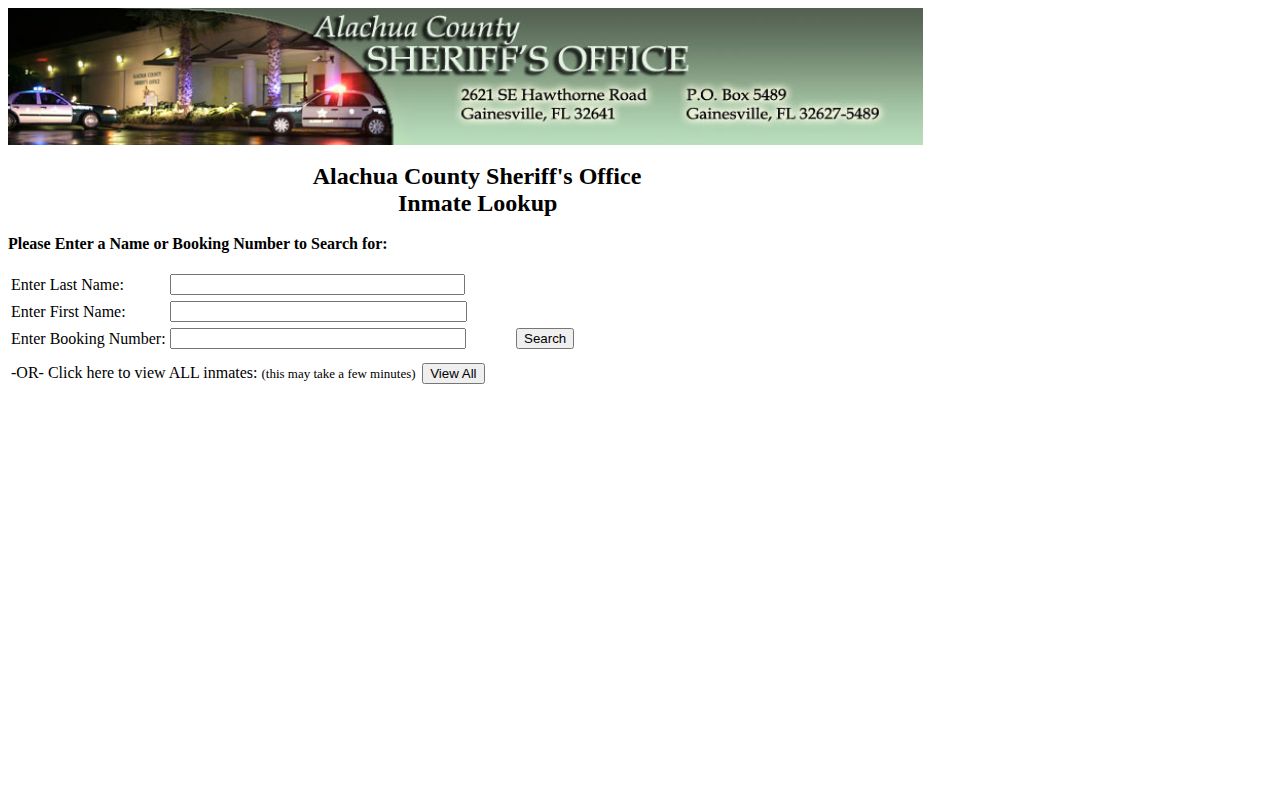
The lack of a date-window control is why a three-day release request must go through ACSO records.
Alachua Weekend Release Timing
Ordinary first appearance takes place at 9 a.m. on weekdays and 9:30 a.m. on weekends and holidays. The hearing is one step, not the final exit. Booking Support warns that processing after judicial release may take several hours. That gap can push the booking-out time into a different day from the court order.
Several local factors can slow an Alachua County release: document errors, warrants, detainers, registration or testing, electronic monitoring, a Nebbia hearing, medical or security events, and late court paperwork. A Nebbia hearing concerns the source of bail funds. During a holiday period, check both the order date and the completed release time rather than assuming they match.
The Alachua Clerk docket can establish the legal action. ACSO establishes when local custody ended and where the person went. Florida VINE can add a quick alert but may lag an agency transmission. Each channel answers a different part of the question.
Note: A 72-hour window should be defined by actual start and end dates, especially when a weekend or holiday crosses the search period.
Alachua Three-Day Fallback Chain
Start with ACSO for an Alachua County jail event. The release record is the primary county source, while the Clerk docket supplies bond, recognizance, dismissal, or sentencing authority. The Alachua County released inmate lookup explains the wider named-person path when the last custodian is uncertain.
Use FDC only if a state-prison sentence or state supervision is possible. Its Inmate Release search contains state records for people released or scheduled for release and is updated nightly. FDC expressly excludes county-jail-only sentences and county probation. A person transported from ACSO to FDC has left the county jail but has not been discharged from state custody.
Federal and immigration transfers also need separate checks. The BOP locator covers federal prison records, not USMS pretrial custody. ICE ODLS applies after ICE obtains custody. Florida VINE is not a substitute for either federal system. When ACSO's record names a receiving agency, follow that destination.
Read Alachua Release Dispositions
A three-day list is useful only if each disposition is read correctly. Bond or ROR releases a person from that booking while the case continues. Time served means the custodial portion recognized by the order was completed. A dismissal ends the cited prosecution but does not cancel an unrelated hold. A transfer closes ACSO custody into another agency's custody.
- ROR
- Release on one's own recognizance without a financial bond for that case.
- Purge
- A child-support payment or superseding court document that satisfies the stated release requirement.
- Detainer
- A request or hold from another authority that can affect release or cause transfer.
- Booking-out
- ACSO's final process for closing the local custody event and recording the disposition.
Cash and surety bond releases require valid paperwork, identifiers, and verification. For a time-served order, Booking Support checks the judgment and sentence and any amendment. These controls help explain why a court event and actual release can occur hours apart.
Alachua Roster Data Limits
ACSO gives no public promise for roster refresh speed or the time a completed booking remains visible. Booking Support works around the clock, but staffing hours do not establish a web update schedule. Florida records-retention rules likewise do not tell how long an item will stay on the public portal.
A local report observed POD “BO” during booking-out before a record disappeared. The Sheriff does not publicly define that code. Treat it as an unverified observation, not as a release field or a way to build an Alachua County 72-hour list.
The official sheriff app is another limited channel. Its public description lists news, tips, reports, and public-safety functions, but no recent-release feed is documented. Verify any in-app feature before relying on it. A written ACSO record remains stronger than a transient screen.
Reconcile Alachua Three-Day Events
A three-day review may contain several dates for one person. The booking date identifies the local custody event. The order date identifies when a judge acted. The bond-payment time records a financial step. The release time identifies when ACSO finished booking-out. Keep each date in its own column instead of turning the earliest one into the release date.
Use the Alachua Clerk court-record search to locate public orders and docket entries. Then ask ACSO to match the case to the booking number and release event. If a later booking appears during the same three-day span, treat it as a separate event. The live roster may show only the current event and does not reconstruct the sequence.
Florida records schedules set minimum retention for booking records, commitment and release lists, and incarceration records. They do not create an online three-day feed or promise web access. ACSO may hold responsive records even after the current portal stops displaying a booking. A specific public-records request is therefore the durable route.
If the destination says FDC, check the state offender network after its nightly update. If it names another county, contact that county. For USMS or ICE, follow the federal or immigration source. The destination closes the gap between “released by ACSO” and “returned to the community.”
Keep a copy of the response and note which dates ACSO searched. If the range was interpreted differently, restate it with full calendar dates and ask for the existing record by booking identifier.
Public Record Search
Sponsored Results