
Alachua County Projected Release Date
A projected date is a working calculation. It is not proof that a person left custody. Florida law calls FDC's computation a tentative release date. The public active-inmate detail labels the estimate Current Release Date and warns that it can change through gain-time awards, forfeitures, or review. Once an FDC release is complete, the released detail uses the historical label Release Date. Those labels describe different stages.
County custody has another track. Booking Support verifies a judgment-and-sentence order and any amended order for a time-served release. A pretrial booking often has no fixed end date. Bond, recognizance, dismissal, a new order, or another hold can determine when custody ends. Even after a judge signs an order, jail processing and a receiving-agency transfer may affect the actual departure time.
The distinction also prevents a custody error. Transfer from the county jail to FDC ends the local booking, but it starts or continues state custody. A transfer between FDC facilities changes location without creating a release. A detainer can lead to another agency receiving the person on the date local custody ends.
Lookup Alachua County Release Dates
Begin with the last known custodian. The ACSO live portal only confirms current county-jail custody. It does not show a projected or completed release field. For a state prisoner, start from the FDC offender-search hub. Direct search links can lose their search type, so select the correct database from the hub.
- Search ACSO by name or booking number when the person was last held in the Alachua County jail. A current hit establishes custody, not a release date.
- Read the Alachua Clerk docket for the judgment, sentence, release order, bond order, or amendment that controls the county case.
- For a state sentence, choose FDC Inmate Population and match the six-character DC number, name, birth data, photo, offense, and county.
- Read Current Release Date exactly as shown. “TO BE SET” means the public system does not yet supply a date.
- For a county sentence, call ACSO Booking Support at (352) 491-4449 or (352) 491-4459 and ask for the current computation tied to the order.
- After release, verify the completed date in the county booking-out record or FDC Inmate Release search.
The official FDC search hub appears in the captured source below.
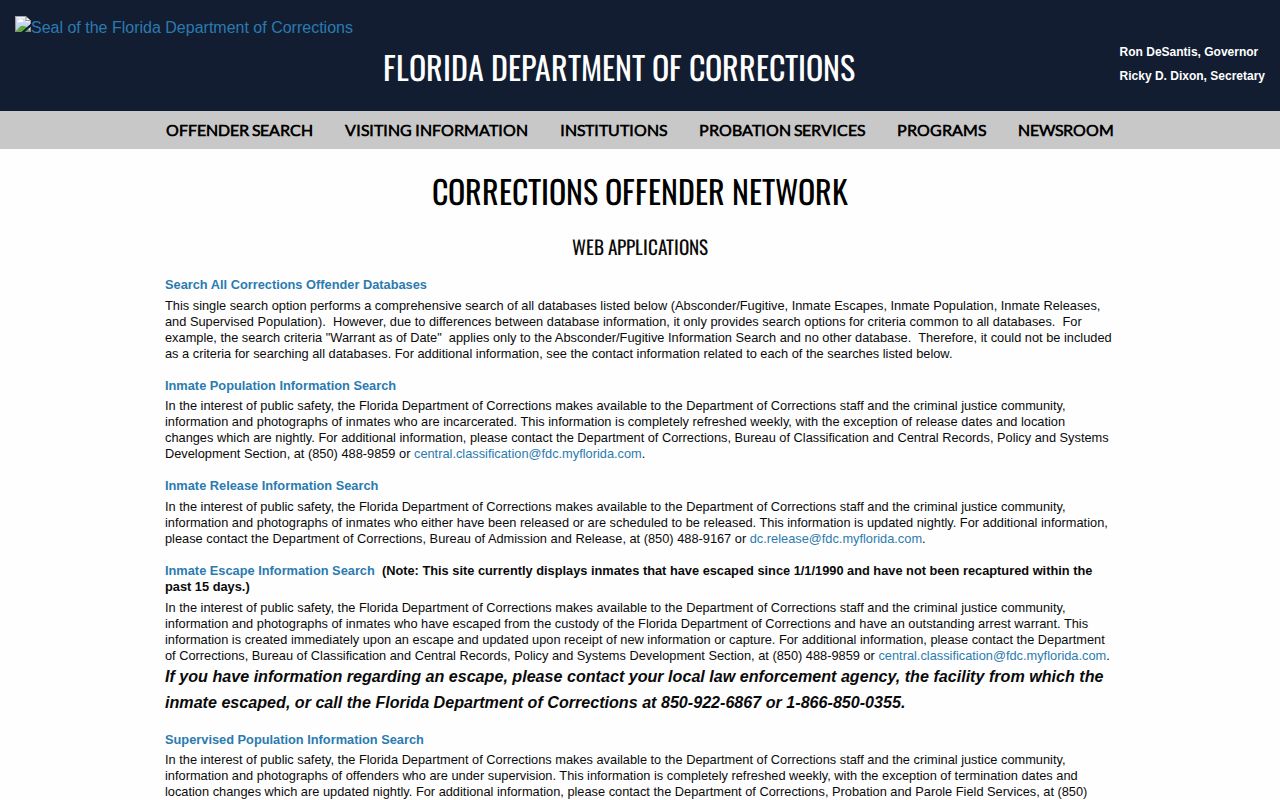
The separate population, release, supervision, and absconder databases show why a user must choose the system that matches the stage of custody.
Note: FDC excludes county-jail-only sentences and county probation, so its Current Release Date cannot be assigned to an ACSO-only booking.
FDC Alachua Release Date Fields
An active FDC detail combines identity, sentence, custody, and date data. It can show the DC number, name, race, sex, birth date, current facility, sentence history, and Current Release Date. A released detail changes the emphasis to Release Date and adds incarceration history with dates in and out of custody. The state data update at different cycles, with release-date and location changes updated nightly according to FDC.
| Field | Record stage | How to read it |
|---|---|---|
| Current Release Date | Active FDC record | A calculated, changeable date, not a completed discharge. |
| TO BE SET | Active FDC record | The calculation is still pending in the public display. |
| Release Date | FDC release record | The historical date FDC custody ended for that record. |
| Date Out-Custody | Incarceration history | The close date for a custody period; later custody may still exist. |
| Supervision status | Separate supervised record | Shows state community supervision after prison, where applicable. |
The manifest screenshot comes from an official FDC active detail with a Current Release Date.
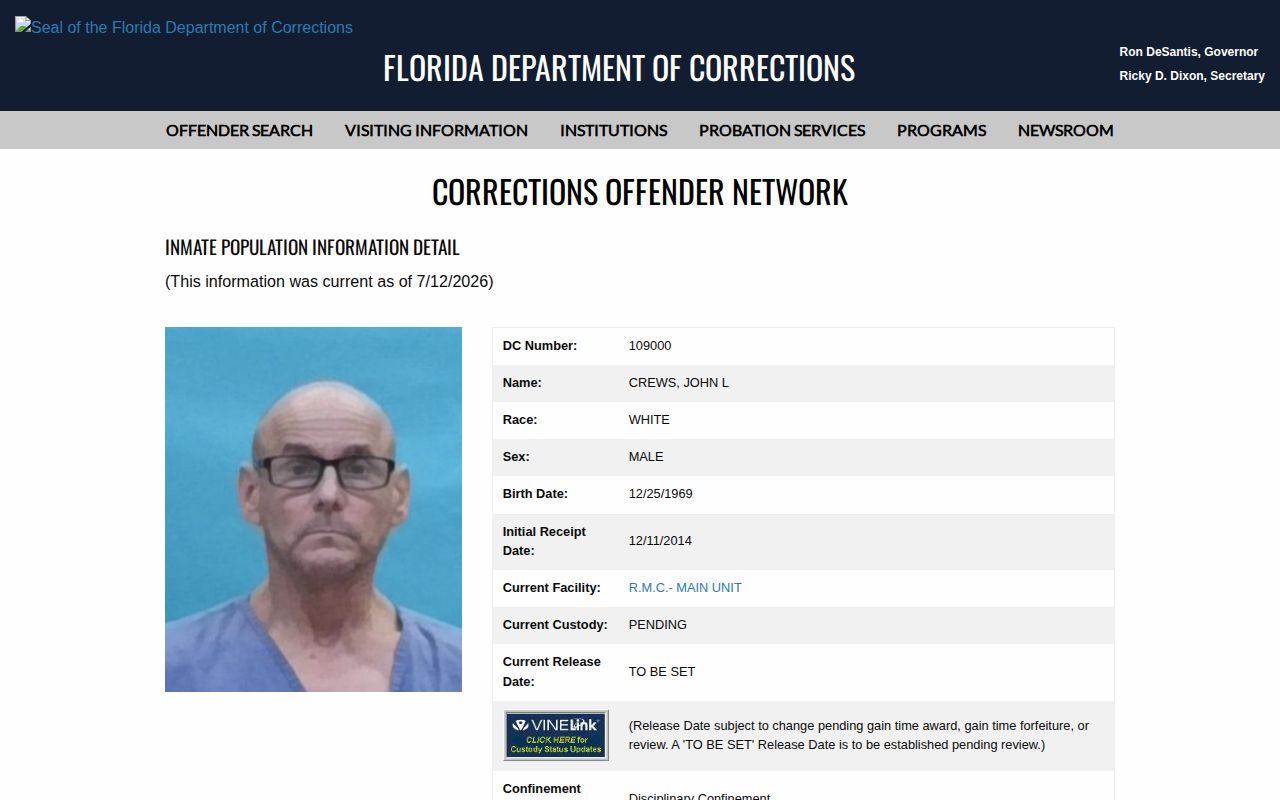
The date warning on the state record supports treating the value as a live computation rather than a guaranteed exit day.
Florida State Release Computation
Florida Statute § 944.275 directs FDC to establish a maximum sentence expiration date after applying lawful credit. It also directs FDC to calculate a tentative release date based on gain-time granted or forfeited. An award or restoration can move that date earlier. A forfeiture can move it later. The tentative date cannot be later than the maximum expiration date.
Gain-time rules depend on the offense date and statutory eligibility. Basic gain-time of ten days per month applies to the historical offense-date band from July 1, 1978 through December 31, 1993. It should not be promised to a modern prisoner. For offenses on or after October 1, 1995, FDC may award up to ten days per month of incentive gain-time, subject to exclusions. Some serious offenses are ineligible under the relevant law, and discipline can cause forfeiture.
The modern truth-in-sentencing rule creates a floor. A person subject to § 944.275(4)(b)3 cannot receive gain-time that would cause release before serving 85 percent of the imposed sentence. Credit for time physically incarcerated counts toward that floor. Yet 85 percent is not a promised release point. Sentence structure, mandatory terms, eligibility, awards, forfeitures, and review all matter. A life sentence remains life unless lawful pardon or clemency changes it.
The captured Florida gain-time statute shows the governing terms for tentative dates and the service floor.
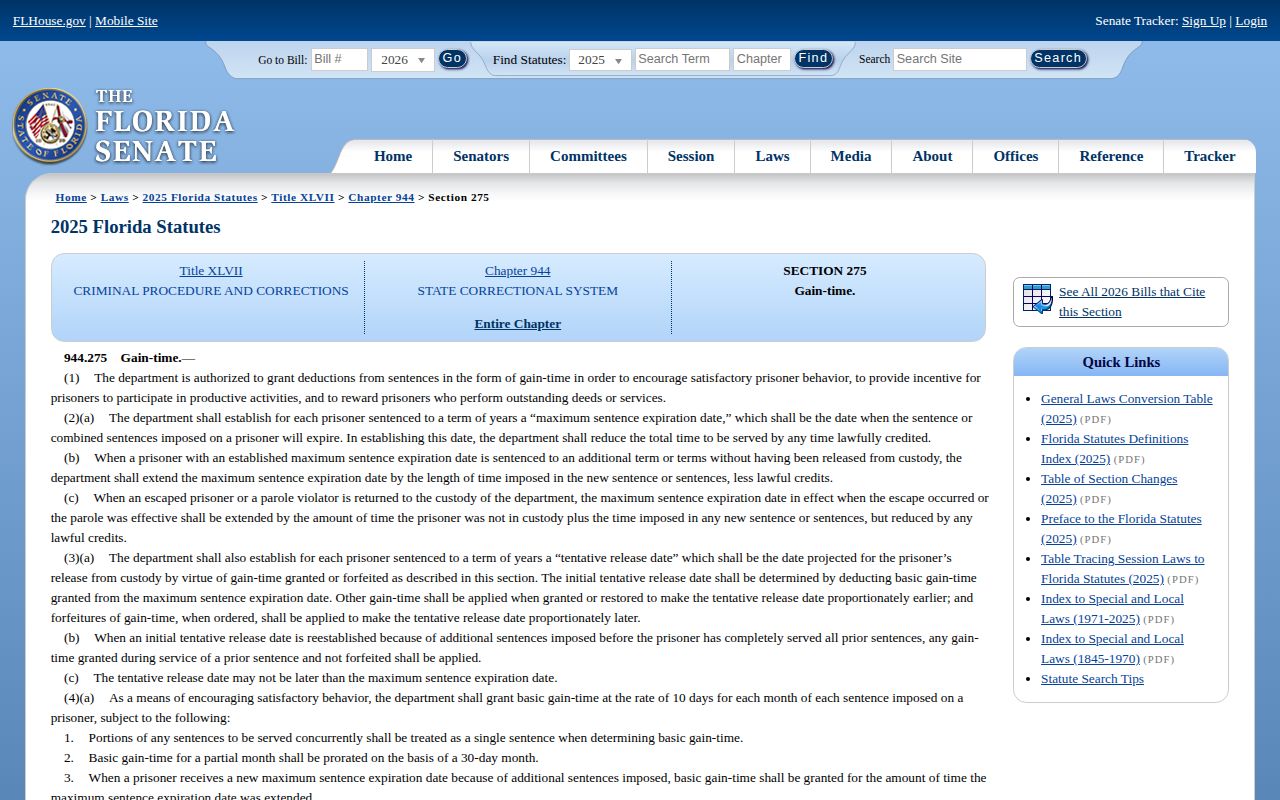
Its rules belong to state-prison computations and should not be copied onto the Alachua County jail policy.
Alachua Pretrial Release Dates
A pretrial detainee has not received a custodial sentence on the pending case, so there is no sentence end date to compute. The court may set bond, release the person on recognizance, impose pretrial supervision, or keep the person in custody under the lawful order. The Clerk docket can show the legal authority, but the jail booking-out record supplies the actual completion time and destination.
Alachua County Pretrial Services interviews eligible detainees before first appearance and operates several community-supervision levels. Its Centralized Screening Team reviews eligible detainees who remain in custody 96 hours after first appearance. That review is not a promised release date. It is one local process that may inform court or pretrial action while the booking remains open.
Bond also starts a process rather than an instant exit. ACSO verifies cash-bond or surety-bond paperwork, identifiers, and court information. Another warrant, detainer, registration requirement, monitoring arrangement, delayed order, medical event, or document problem can postpone departure. When timing matters, call Booking Support and ask whether the release authority has cleared and whether another custodian will receive the person.
County probation is different again. It generally handles misdemeanor or criminal-traffic sentences, while FDC handles state supervision. A probation termination date is not a jail release date, and a pretrial reporting date is not a sentence expiration date. Use the label from the exact order.
Alachua County Jail Gain-Time
Alachua County's local policy is the distinctive calculation issue. Florida § 951.21 permits a county gain-time framework, while the ACSO inmate handbook supplies the local terms. Gain-time is discretionary. It excludes civil or contempt cases and cases in which the court bars it. Five good-conduct days can be earned for each full 25 misconduct-free days. Inmate-worker credit is one day for each six worker-status days, and qualifying programs can yield up to three days.
The caps matter. Worker plus program credit is capped at five days per 30 days. Total county gain-time is capped at ten days per month. ACSO also warns that an award may not shorten the estimated end date day-for-day and can be audited. This is why simple arithmetic from the sentence date is unreliable.
Booking Support checks the judgment and sentence plus amended orders. Court changes, earned or forfeited local credits, other holds, required registration or testing, electronic monitoring, and document problems can alter the working date. Ask for the current computation attached to the exact booking. Do not apply the state 85-percent formula to an ACSO county-jail sentence.
Note: Alachua County jail credits and FDC state-prison gain-time are separate systems, even when the same court case appears in both records.
Alachua Sentence Expiration Dates
The maximum sentence expiration date and the tentative release date answer different questions. The maximum date reflects the imposed sentence after lawful credit. The tentative date incorporates gain-time that FDC has granted or forfeited. A person may therefore have both fields in the underlying computation even though the public page emphasizes Current Release Date.
Mandatory terms, combined sentences, offense-date rules, court credit, and statutory exclusions can shape the calculation. Court credit for time physically incarcerated counts toward the 85-percent floor when that modern rule applies. FDC, not a web user, performs the official state calculation. For a disputed date, contact the Bureau of Admission and Release with the DC number, sentence, and relevant order.
A completed Release Date becomes historical evidence. It does not prove that all supervision ended or that no other agency took custody. Check FDC's Supervised Population data for state post-prison supervision and check the county release destination when the state term began with an ACSO transfer.
Why Alachua Release Dates Change
A date can move for legal, administrative, or custody reasons. The change does not always mean the earlier display was wrong. It may reflect a new event. Preserve the dated history and identify which agency updated the record.
| Factor | Possible effect | Confirm with |
|---|---|---|
| Gain-time award or restoration | May move an eligible calculated date earlier. | FDC Admission and Release or ACSO Booking Support |
| Disciplinary forfeiture | May move the date later. | The agency computing the sentence |
| Amended court order | Can alter the sentence, credit, or release authority. | Alachua Clerk docket and custodian |
| Warrant, detainer, or hold | Can delay departure or cause transfer to another agency. | ACSO, FDC, and receiving agency |
| Parole or conditional-release action | May establish or change a release step and supervision plan. | FCOR final order and FDC record |
| Registration or electronic monitoring | Can delay local booking-out processing. | ACSO Booking Support |
FCOR's posted meeting date is not itself a release date. A panel may affirm or modify a presumptive parole release date, and a later decision may address an effective date or an unsatisfactory release plan. Request the written order, then check the FDC record after its update.
Confirm Alachua County Release
Use the projected date to plan a follow-up, not to announce a completed release. On or after the expected date, check the relevant release record. For the county jail, request the booking-out date, time, authority, destination, and receiving agency from Department of Jail Records at (352) 491-4444. For FDC, check Inmate Release Information and the incarceration history. FDC's Bureau of Admission and Release can answer release-data questions at (850) 488-9167 or dc.release@fdc.myflorida.com.
VINE can add a rapid alert, but it is not the formal record. A release alert may mean release from one agency followed by transfer to another. The Alachua County VINELink Inmate Search explains the specific-person alert path. Confirm the wording and source agency after each notice.
The Alachua County released-inmate record path can then reconcile the jail record, court order, and state system. That sequence distinguishes an estimate from the actual custody event and from any supervision that follows.