
Alachua VINELink Release Coverage
Florida VINE is the statewide custody-status and notification service. Official Florida material describes coverage of county jails, FDC prisoners, and DJJ records. For an Alachua County search, open the person record and verify that the source agency is ACSO, FDC, or the correct participating agency. The live agency list can change, so the source label matters as much as the name.
VINE performs two distinct jobs. It can display status information for a specific person, and it can register contact methods for custody-change notices. It does not create the jail's booking-out record. Nor does it certify the court disposition. A missing result is inconclusive because the interface is dynamic and no universal Florida retention period for released results was verified.
Federal prison and immigration custody sit outside Florida VINE. BOP has its own inmate locator. ICE has the Online Detainee Locator. A USMS pretrial matter may require the federal docket and the holding facility because USMS does not offer an equivalent public release locator.
Search One Alachua Inmate
Begin at the Florida landing page rather than a saved result. Direct sessions can change, and a fresh state selection makes the data source clearer. Have a date of birth or offender number ready when names are common.
- Open Florida VINE and choose the person or custody search.
- Enter the identifying fields offered by the live interface. Add date of birth or offender number to separate same-name results.
- Open the matching record. Check the name, offender number, source agency, current status, and facility or location.
- For an FDC record, read any sentence-expiration or scheduled-release information as a changeable state value, not a county-jail release date.
- If a recently released result appears, save the exact wording and date. If nothing appears, contact ACSO or FDC because absence does not prove release.
The Alachua County released inmate search supplies the broader records path when VINE cannot resolve the event. It begins with the last known custodian and follows the destination across county, state, or federal systems.
The official Florida VINE person-search screen is shown below.
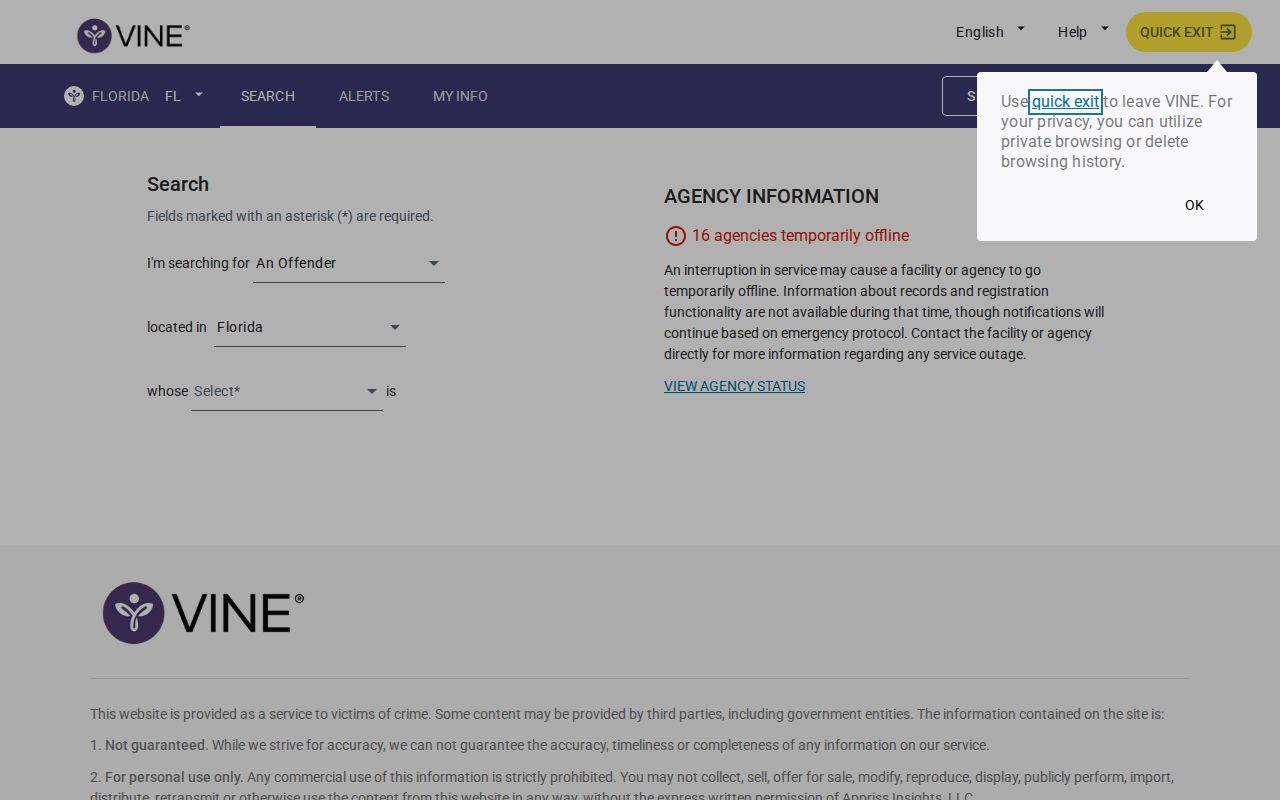
Use its person search to locate one record, then confirm the source agency before interpreting status.
Alachua VINELink Status Fields
Florida telephone materials describe the main data that VINE can report. The live web interface may vary by source agency. Read the fields together, especially agency, location, and event type.
| Field | How to read it |
|---|---|
| Name and offender number | Distinguish the intended person from someone with a similar name. |
| Source agency | Shows whether the record comes from ACSO, FDC, DJJ, or another participating source. |
| Custody status | Describes the status sent by that agency; it is not a court judgment. |
| Facility or location | Identifies the reported custodian or placement at the time of the update. |
| Scheduled release information | May appear in FDC telephone data and can change before actual discharge. |
| Notification method | Records phone, text, email, or app delivery choices offered after registration. |
Research did not verify a stable Florida released-person screen, universal result label, or retention window. Do not promise that every recently released Alachua County person stays searchable. Capture the precise status shown and corroborate it with the source agency.
Register Alachua Release Alerts
Phone registration is available through Florida VINE at 1-877-846-3435, around the clock. Use a direct number. A switchboard or service that requires the caller to announce itself may prevent the automated notice from reaching the intended person.
- Call the Florida VINE number and follow the prompts to identify the person.
- Select notification and enter a direct telephone number with area code.
- Choose a four-digit PIN. If none is chosen, FDC's paper form says the last four phone digits become the default.
- Enter the PIN when the automated call arrives. This confirms receipt and stops repeat calls.
- Call back to confirm registration and update the service whenever the phone number changes.
Official Florida guidance says unanswered or busy calls can repeat for up to 48 hours. An answering-machine notice can repeat every two hours until the PIN is entered or the period ends. A release or escape call may arrive overnight. The PIN should be kept private from anyone who might answer and cancel the notice.
After finding the person online, choose the notification action and the available phone, text, email, or app method. Enter contact and language information, set or re-enter the PIN when prompted, and complete confirmation. Text and email notices do not repeat in the same way as phone calls.
Confirm Alachua VINELink Alerts
Alert wording must be tied to the custody event. “Release” can mean ACSO closed its booking after bond or time served, but the destination could still be FDC, another county, USMS, or ICE. “Transfer” is a change of custodian, not a community release. “Out to court” is temporary movement. Death ends custody but should not be described as release.
For an ACSO event, check the current county roster, then call Department of Jail Records at (352) 491-4444 and request the booking-out record with release time, disposition, holds, and destination. The ACSO records route supports a written request. For state prison, use the FDC Inmate Release search. It covers FDC records and is updated nightly, but it excludes county-jail-only sentences and county probation.
VINE cannot prove that a person who left one system is free from all custody or supervision. The court docket can show the legal order behind a release. FDC's supervised-person search can show state supervision after prison. The receiving agency controls the next custody record.
Florida VINE Update Timing
An official Florida VINE guide distributed by a sheriff's office states that county-jail data transfer every 15 minutes around the clock. It states that FDC data transfer every 30 minutes from 7 a.m. to midnight, every day. Those are documented statewide operating intervals, not a separate ACSO contract or a guarantee that each screen updates without delay.
Agency entry, network transmission, and interface processing can each add lag. A newly signed order may also precede actual booking-out. When timing matters, keep the alert, note the time received, call the source facility, and obtain the release record. That chain is stronger than a single screen.
Note: A saved VINE notice records what the service reported at that moment, while the custodian's record establishes the completed event.
Florida Notification Registration Layers
Direct VINELink registration and FDC's Victim Services database are not automatically the same registration. FDC's printable form directs nonvictims and concerned users to register directly through VINELink. Its separate victim-notification form supports the FDC program. No one needs to claim victim status to use the purpose-neutral VINELink route.
A newer VINE account may send a six-character code by text or email to verify the account. That code is separate from the four-digit phone-notification PIN. The account code verifies access. The phone PIN confirms receipt of an automated alert and stops repeat calls.
The FDC notification form pictured below documents the Florida-specific registration layer.
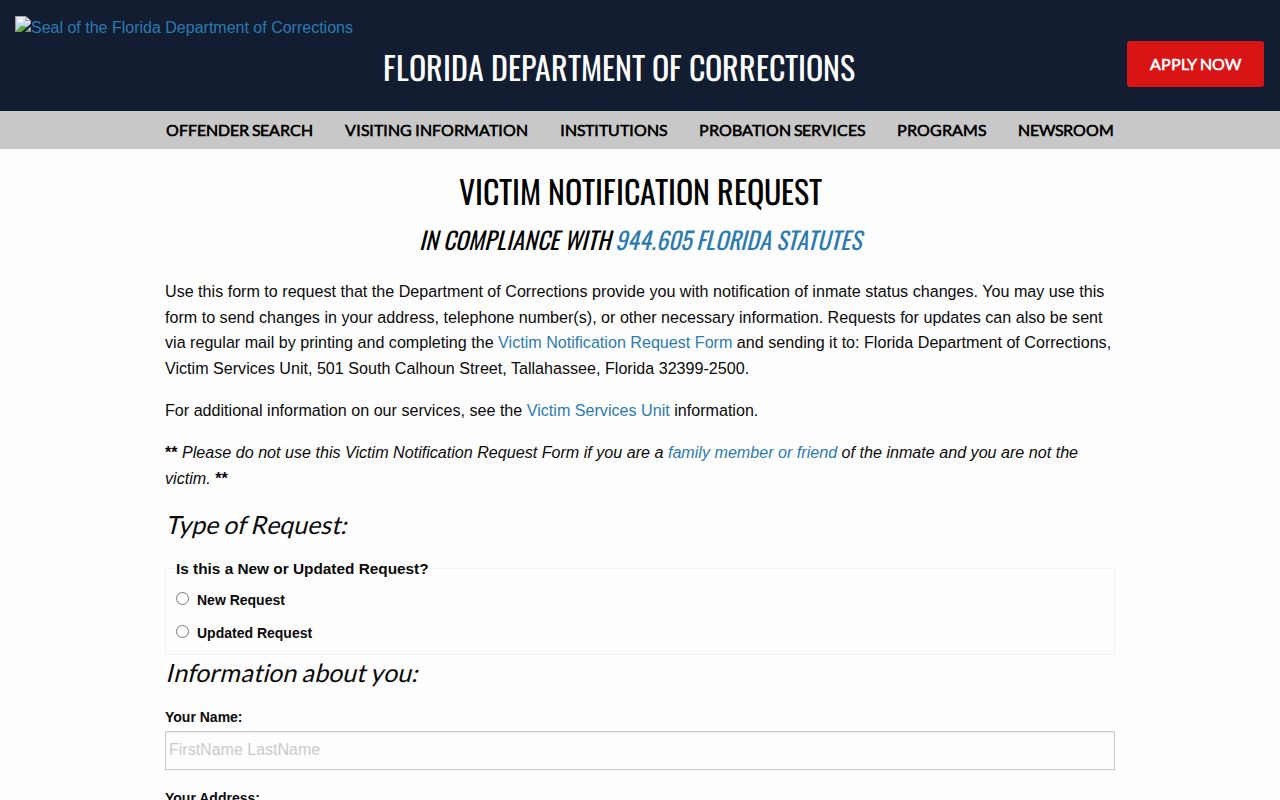
Its separate process is a reminder to confirm which system holds each registration and to keep contact information current in that system.
Read Alachua Custody Alerts
Notification categories should be reported in plain, precise terms. Release from ACSO says the county custody record ended. Transfer says custody moved. Out to court is temporary movement. Escape is not release. A death notice also must not be described as release. These distinctions matter when a person has more than one case or another agency has lodged a hold.
- Release
- The source agency reports that its custody event ended, subject to confirmation of destination.
- Transfer
- The person moved from one custodian or placement to another.
- Scheduled release
- A prospective date that can change before actual discharge.
- Discharge
- The end of the stated custody or supervision term, depending on the source record.
After an ACSO alert, request the booking-out record. After an FDC alert, compare the active or released offender detail. The Alachua Clerk docket can establish the order or sentence that shaped the event. Where another agency receives the person, that receiving source controls the next status.
Alachua VINE Versus Registries
Florida's offender registries are not substitutes for VINE. The FDLE Sexual Offender and Predator Registry has a defined status called “Released - Subject to Registration.” It applies only to a person legally required to register. The Career Offender Registry also offers custody and released status categories for qualifying records. An ordinary released person may not appear in either system.
The local ACSO Jail Lobby Registration Office handles felon, career-offender, and sexual-offender or predator registrations. Its posted hours are 11 a.m. to 7 p.m. Monday through Friday, with weekends closed and holiday operation noted as “until further notice.” Registrants need current photo identification, and ACSO says the process generally takes 20 to 30 minutes. The jail number is (352) 491-4444, extension 2158.
This registration step can occur near booking-out and may explain why a qualifying registry record becomes relevant soon after custody ends. Yet registry absence proves nothing for a person outside the covered law. For most Alachua County release checks, VINE, ACSO, the Clerk, and FDC form the proper chain.
Alachua County and FDC Records
Source scope prevents a common mistake. An ACSO VINE record concerns the county-jail event. An FDC VINE record concerns state prison or another state corrections status. FDC's public database contains people sentenced to state prison or state supervision, and it expressly excludes county-jail-only sentences and county probation. A person can therefore leave ACSO without appearing as an FDC release.
When the Alachua County booking-out record says FDC transport, the person has changed custodians. Search the FDC offender network for the current facility or later release history. When FDC eventually reports release, read any supervised-population record separately. Release from prison and the end of supervision are different events.
VINE helps connect those events through alerts, but the formal records remain agency-specific. Record the source agency shown on every notice. That small step keeps a county release, state discharge, and later supervision from being collapsed into one vague status.
Public Record Search
Sponsored Results