
Alachua Academy Release Pathways
Release from Alachua Academy is a planned juvenile placement change. A girl may step down to a less restrictive setting, return to a guardian under conditions, enter community supervision, or move to another DJJ program. The correct outcome depends on her individual assessment, progress, treatment plan, DJJ placement work, and the authority of the juvenile court. Departure from the campus does not necessarily end DJJ supervision or the underlying court case.
Because Alachua Academy is a residential commitment program, its release language differs from a jail booking-out record. The useful questions concern the date the Academy placement ended, the placement or guardian receiving the youth, any supervision or service plan, and the court order that authorized the change. Those details are generally available only through protected, case-specific channels.
Confirm an Alachua Academy Release
An authorized person should begin with DJJ and the assigned case contacts. The Academy's provider operates the program, but Florida owns the facility and DJJ controls placement within the juvenile commitment framework. The juvenile court record supplies the legal authority when a court order governs the change.
- Verify that Alachua Academy is the youth's current or last known residential placement.
- Collect the juvenile case details and proof of the requester's authority to receive protected information.
- Contact the assigned DJJ representative or Academy program contact through the official DJJ channel.
- Ask whether the change is discharge, step-down, guardian return, community supervision, or transfer.
- Review the related juvenile-court order and follow-up requirements through an authorized court channel.
The adult Alachua County release search routes apply only when the person and custodian belong in those systems. ACSO current custody and FDC state-prison records do not prove an Academy placement or release.
Note: Public silence about a youth is often a result of confidentiality, not evidence that the placement has or has not ended.
Alachua Academy Placement Contact
The official DJJ facility profile identifies the Academy, provider, population, and program type. It is the safest public entry point. For a named youth, the requester should use the assigned DJJ and juvenile-court contacts and be ready to establish a lawful relationship to the case. No general public release-record number is supplied in the research, so none should be inferred from nearby facilities.
Alachua Academy3430 NE 39th Avenue
Gainesville, Florida
Provider: Rite of Passage, Inc.
Agency framework: Florida DJJ
The official DJJ Alachua Academy page confirms the state-owned residential program. The ACSO Jail Records number is not the custodian for Academy placement records, even though the facilities are in the same local area. Agency and court authority, not geography, control where the record belongs.
Alachua Academy Program Records
Alachua Academy is a moderate-risk residential commitment program for girls ages 12 through 18. It has 28 beds. Florida owns the program, and Rite of Passage, Inc. operates it as the provider. “Moderate risk” describes a DJJ commitment level and should not be converted into an adult security classification.
The official DJJ Academy profile is the agency source for the program and its juvenile placement role.
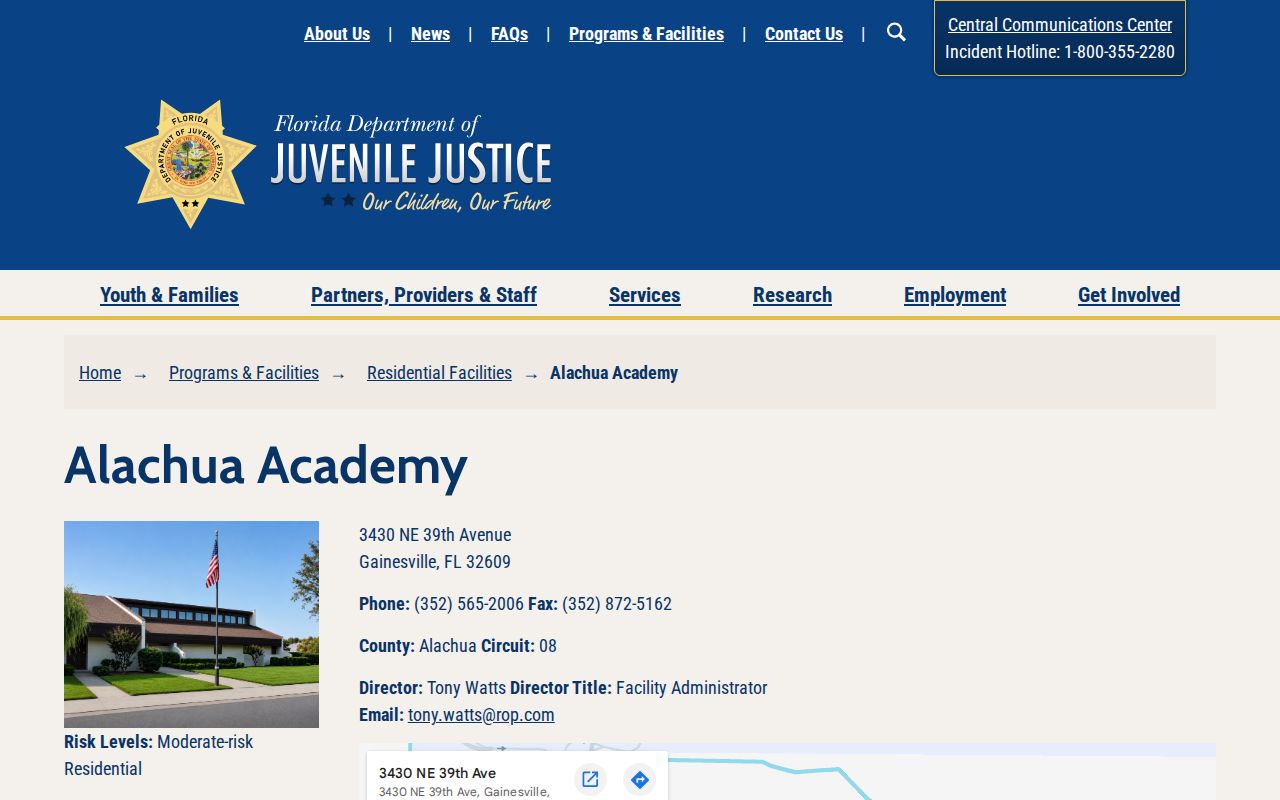
The captured source shows why Academy transition records belong to DJJ rather than the adult county roster.
Residential commitment follows a juvenile-court disposition and DJJ placement process. The provider delivers the program, while release and transition remain linked to state assessment and court authority. Capacity does not reveal the current census. The age range does not mean every youth follows the same length of stay, transition plan, or release schedule.
Alachua Academy Step-Down Decisions
A step-down is movement to a less restrictive phase or placement. It should not be described as a completed release from all legal control unless the order and DJJ record say so. Treatment progress and the individual plan matter, but neither gives a member of the public a formula for predicting the date. The youth's case team and court process resolve when the next placement is appropriate.
For accurate confirmation, ask for the status words used in the actual record. “Transferred” means another placement received the youth. “Returned to guardian” describes who received the youth but may include supervision terms. “Discharged” may describe completion of a program or a broader DJJ status, depending on the record. The words must be read in context instead of translated into adult corrections terms.
Note: A treatment milestone may support transition planning, but only the authorized DJJ and court action controls the legal placement change.
Alachua Academy Record Restrictions
Juvenile, treatment, medical, and assessment information can be protected. Even when an adult public-record law provides broad access to government documents, separate juvenile restrictions may limit the identifying details, case files, and placement information available to a general requester. A public facility directory is not a resident roster.
An authorized request should identify the youth and case, state the requester's relationship, and ask for only the placement facts needed. DJJ or the court may require proof before discussing the case. If access is denied or limited, the requester should ask which custodian or court procedure applies instead of seeking the same facts through the adult jail, FDC, or an unrelated public portal. Those systems have different populations and could produce a false match.
Alachua Academy Placement Differences
Alachua Academy and Alachua Regional Juvenile Detention Center have different roles. The detention center is a short-term secure setting for youth awaiting adjudication, disposition, or commitment placement. The Academy is a residential commitment program entered after the juvenile process reaches the appropriate placement decision. A transfer from detention to the Academy is therefore not community release.
The distinction changes the record trail. Detention records show the secure holding phase and its end. Academy records address the commitment program, treatment plan, progress, and transition. The juvenile court connects the phases through its orders. Families and authorized representatives should name the exact facility and stage when requesting facts, because a generic “release record” may not identify the document they need.
Note: Moving between two DJJ settings ends one placement but continues the youth's juvenile justice case under a new program.
Wrong Alachua Academy Searches
The ACSO inmate portal is limited to current adult county-jail custody. The FDC offender network covers state-prison and state-supervision populations defined by that agency. Alachua Academy belongs to neither route. A missing adult result cannot confirm an Academy release, and an adult with the same name should never be assumed to be the youth.
VINE may include juvenile justice coverage in Florida materials, but it is a status and notification layer, not a public archive that overrides juvenile confidentiality. Any result must be matched to the correct source agency and then confirmed through DJJ. The strongest path remains a case-specific contact by someone authorized to receive the youth's placement information.