
Alachua Juvenile Release Destinations
A departure from Alachua Regional Juvenile Detention Center can have several legal meanings. A juvenile-court order may return the youth to a parent or guardian. DJJ may arrange supervised release in the community. Another order may direct transfer to a residential commitment program or other authorized placement. Each outcome is tied to the youth's case and DJJ plan, so physical departure from this detention center does not by itself establish that all juvenile supervision has ended.
The correct record comes from the juvenile case and DJJ custody process. Authorized people should ask what order controls the move, when the detention placement ended, who received the youth, and what conditions follow. Public adult databases omit that context and may not contain the youth at all. Even when a name happens to resemble an adult record, that match should not be treated as a juvenile release.
Confirm an Alachua Juvenile Release
The Florida Department of Juvenile Justice and the juvenile court are the main channels. Access depends on the requester's authority and the confidentiality rules that apply to the youth and record. A general public search cannot replace direct confirmation from those custodians.
- Confirm that Alachua Regional Juvenile Detention Center is the youth's last known placement.
- Gather the youth's full identifying details and the juvenile case information available to the authorized requester.
- Contact the DJJ facility or assigned DJJ representative and state the requester's legal relationship to the youth.
- Ask whether the center placement ended through guardian return, supervised release, or transfer to another program.
- Review the controlling juvenile-court order with counsel or the clerk channel available to authorized participants.
If the question concerns an adult held elsewhere, use the Alachua County custody and release search routes instead. Keeping the two systems apart prevents a current adult jail result or FDC record from being misread as evidence about a youth.
Note: Lack of a public result is expected for many juvenile records and does not establish either continued detention or release.
Alachua Juvenile Release Contact
The official DJJ facility page is the best public starting point for the center's identity and role. Sensitive case status should be discussed only through the facility, the assigned DJJ contact, counsel, or the juvenile court route available to an authorized person. The research source does not publish a general release-record phone line, so no unsupported contact number should be substituted.
Alachua Regional Juvenile Detention Center3440 NE 39th Avenue
Gainesville, Florida
Agency: Florida Department of Juvenile Justice
Record access: subject to juvenile confidentiality
The official DJJ detention-center page identifies the secure center and the counties it serves. It is a directory and program source, not a public list of youth. For an actual release or placement question, the requester must establish authority and use the case-specific channel. The ACSO public-record request system manages sheriff records, not DJJ juvenile placement records.
Alachua Juvenile Detention Profile
Alachua Regional Juvenile Detention Center is a 45-bed, hardware-secure DJJ detention center. It serves Alachua County plus Baker, Bradford, Columbia, Dixie, Gilchrist, Hamilton, Lafayette, Levy, Suwannee, and Union counties. Youth are held pending adjudication, disposition, or commitment placement. DJJ's official material reports an average stay of about 11 days, but that average is not a release estimate for a named youth.
The official DJJ center profile provides the source view of this Alachua juvenile detention and release setting.
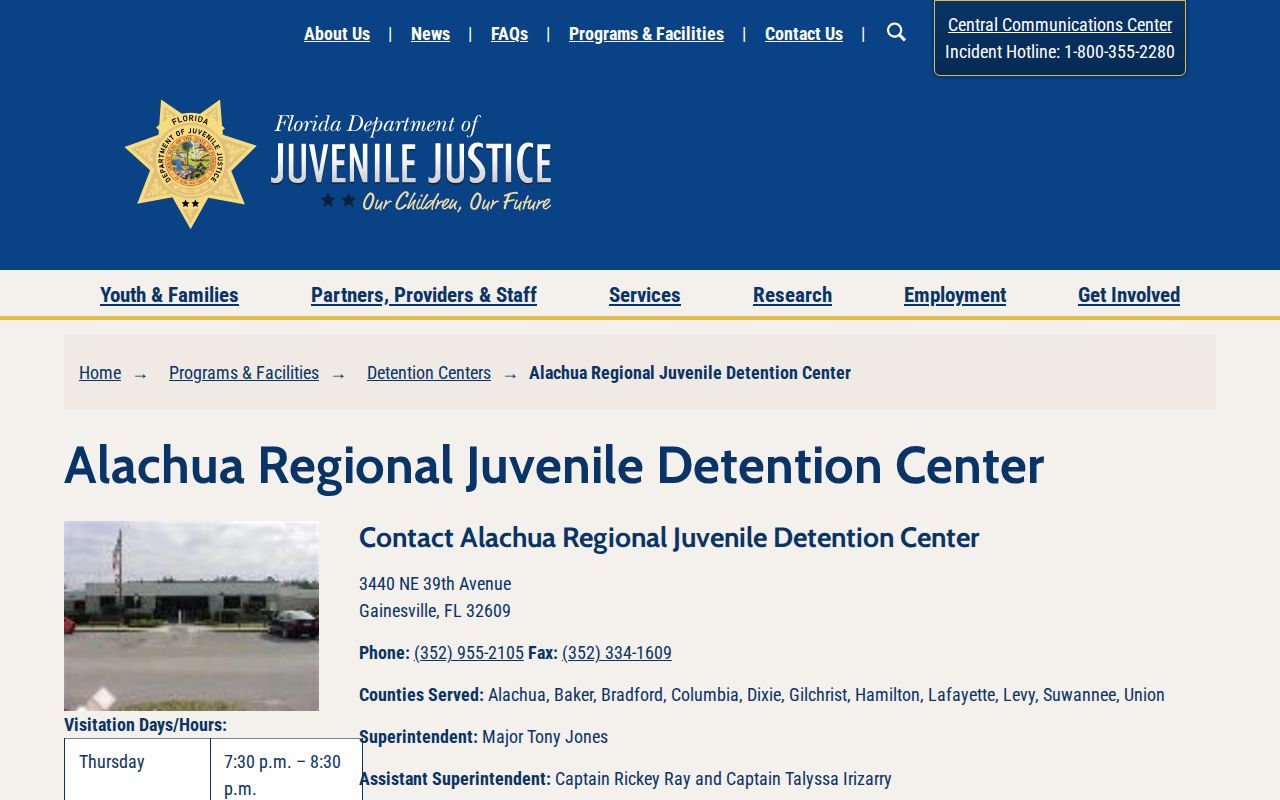
The captured agency page confirms the facility type and reinforces why youth status belongs in DJJ and court channels.
Adjudication is the juvenile-court process for deciding the case allegations. Disposition is the juvenile equivalent of the court's placement or sanction decision. Commitment placement means DJJ has assigned a youth to a residential program under court authority. None of those terms is the same as an adult jail sentence, and the reported average cannot override an individual court order.
Alachua Juvenile Release Record Limits
Florida law treats juvenile information differently from ordinary adult arrest and correctional records. The research identifies juvenile records as restricted and warns against routing this facility through the adult ACSO or FDC search. A public release date that might appear for an adult state prisoner should not be expected here. Treatment, assessment, family, and forensic information may also have added protections.
An authorized request should be narrow. Ask for the detention-placement end, the court order controlling release or transfer, the receiving guardian or placement as disclosure rules allow, and any reporting instructions the requester is entitled to receive. DJJ may require identity and authority checks before discussing the youth. If a record or fact cannot lawfully be disclosed, the absence of public access must not be filled with guesses drawn from social media, adult portals, or an unrelated court case.
Note: Juvenile confidentiality protects the youth and case process; it is not evidence that officials have failed to record the placement change.
Alachua Juvenile Release Process
The center's role is short-term secure detention while the juvenile case reaches its next lawful step. A judge may authorize a return home with conditions. DJJ can supervise a community placement or implement a court-ordered commitment. If the youth moves to a residential program, the detention-center stay ends but DJJ control continues in another setting.
A useful custody sequence is: secure detention, juvenile hearing, court disposition, DJJ placement decision, guardian return or supervised placement, and later completion of any ordered program. Not every case uses each step. The exact path belongs to the individual order and plan. An adult-style question such as “was the inmate discharged” can blur these stages, so the record request should use juvenile terms and identify the particular placement.
Avoid Wrong Alachua Release Searches
The ACSO portal answers whether an adult is currently in the Alachua County jail. The FDC offender network covers felony offenders sentenced to state prison or state supervision. Neither system serves as a public roster for this DJJ detention center. A blank result in both systems is therefore normal and says nothing about the youth's current placement.
Likewise, the nearby street location does not make the center part of ACSO's Department of the Jail. Agency control, record law, and court authority determine the correct route. Use DJJ for the facility placement and the juvenile court for the order. If community supervision follows, ask the assigned DJJ representative how it is documented and who may receive updates. This careful channel choice protects accuracy without exposing restricted youth information.
Note: A youth's transfer to residential commitment ends detention-center placement but does not mean release from DJJ authority.